This past week was a lot of fun for me! I think it was fun for my students as well. For my SOPH LIT class, I introduced them to Dante and his Inferno. First, I asked them to look at the "Prepare to Read" page in their textbooks that gives information about the author and work, and they used a cluster graphic organizer to take notes on these two topics. After that, the students had to answer 7 anticipation questions so that I could gauge their background knowledge of some of the themes and motifs.
Through these anticipations questions, I found that most of my students had no knowledge of the "7 Deadly Sins." So, the next day, we spent class time talking about these deadly sins: what they mean, what they are also known as, and how these seemingly natural human responses and actions (anger, hunger, lust) could become so intense that they would be considered sinful. The students were very interested in this discussion and asked great questions! After this, we only had about 10 minutes of class time left, so I showed them the first few slides of my "Journey through the Inferno" PowerPoint slide show (on which I'd worked for 6 hours last weekend!). Through these slides, the students were introduced to the main characters, Limbo, River Ascheron, and boat-keeper Charon.
On Wed and Thurs, I took my students through the rest of the slide show. As they learned, they had to take notes on a handout I entitled "Highway through Hell." I listed each Circle, Ditch, and Ring in the Inferno, and the students had to take notes about what type of sin landed a soul in that particular level, what their punishment is, and who some of that level's residents are. They didn't complain ONCE about the notes! In fact, while they were taking notes, they were asking questions and making comments. It was a lot of fun (and well worth the 6 hours of prep)!
On Friday, we read the version of Canto I that appears in our Reader's Companion workbook. This has a combination of original translated text and paraphrased sections, so it's a little easier to read. This allowed the students to focus on learning and practicing the important concepts of interpreting allegory and identifying magery. They said that they would prefer to read the entire original translated text out of the textbook than reading these adapted versions. ...Of course, they'll get that chance next week as we continue our study.
In my JR LA class, we finally began our study of the Harlem Renaissance. On Monday, I started us off with a PowerPoint show of the history, people, and culture of this period. I printed a handout with blanks where key words or phrases are in the original slide show, and the students took notes as we went through the slides. They enjoyed and had many questions and comments about the visual arts that I included in the show. Toward the end of the presentation, I mentioned that jazz and blues were key music styles during this time, and found that some of my students were familiar with jazz, but none of them knew the blues! I had to remedy this....
On Tuesday, I brought in some songs performed by Duke Ellington, Billie Holiday, and Louis Armstrong. All of them were recorded live performances, and I told the students to imagine being inside of the Cotton Club (they'd seen pics of this club during the slide show on Monday) while we listened to them. After these songs, I played some contemporary examples of jazz and blues songs (of course I had to introduce them to my beloved blues!) so they could hear how music evolved in 40-60 years. After we listened to the music, we read "The Tropics of New York" by Claude McKay and discussed the tone and theme of the poem.
Wednesday through Friday, we studied the poetry of Langston Hughes (some of my favorites!). We discussed how Hughes uses words to capture the rythm and spirit of Harlem in "Juke Box Love Song;" and how the themes of hope, pride, and disappointment are apparent in poems like "Harlem," "Dream Deferred," "I, Too," and "The Negro Speaks of Rivers." With each poem, I stressed that Hughes's poems were short, but he packed SO MUCH meaning and heart into every line. With that in mind, we explicated each poem, getting closer to the heart of meaning for each one. The students enjoyed this and appreciated the Hughes's depth. For homework, each student had to choose one of these poems and write a contemporary version of it that was applicable to his or her life experiences. I expected resistance to this assignment, but they were all eager to get started. I even showed them my own version of "The Negro Speaks of Rivers":
"The Woman Speaks of Trees"
by Ms. Bobbie Greene
I have known trees:
I’ve known trees as ancient as the sound of the waves and older than the gray, granite rock of the mountains.
My soul has grown deep like the roots of the trees.
I climbed the sycamore when the stars were young.
I built a fort in an old walnut and it protected me from the storms.
I looked upon the massive roots of the banyan that seemed to hold up the clouds above.
I heard a coconut fall from a palm as the black earth baked in the early summer sunshine and the salty breeze cooled the herons in their canopy-top nests.
I’ve known trees:
Ancient, mossy trees.
My soul has grown deep like the roots of the trees.
Sunday, March 7, 2010

Thursday, February 18, 2010
I've Been Displaced
At the beginning of this week, all teachers received notice that there would be personnel cuts in many of our county's schools. On Wednesday, I found out that I would be one of the teachers to be involuntarily displaced. They do not have enough students to justify keeping me and 20 other teachers on staff, so we are being sent to other schools to fill open positions. I am not angry about this development...I am mostly stressed out that my job status is relatively uncertain at present, and I am sad to be leaving the people here.
This school has been a wonderful place for me to grow and improve as a teacher. I received my SIOP Model training here, I've had the opportunity to teach new material, I've had more support than I could have hoped for, and I've had resources (adapted versions of texts, a wonderful Media Center, awesome suggestions from other teachers) that have made all the difference in my teaching.
With this weighing on my mind, though, I still have a job to do. Today in SOPH LA, we played Julius Caesar Jeopardy. It's always fun to see how competitive the students get when it comes to winning extra credit points for their test. It always happens that the losing team sees how far they are behind the winning team, so they kind of give up on trying to answer the questions. So, one of my students suggested that we have the "Double Jeopardy" question next time on which the teams can wager as many of their points as they want...so the losing team still has hope that they may come out ahead. Great idea! Why didn't I think of that before? See...even as teachers, we are always learning. :) Tomorrow, the students will take their Julius Caesar test, and next week they have to present their projects for this unit. After that, we get to start our unit on Medieval Lit and Dante's Inferno! I already have some great ideas for helping the students understand the content and language of this piece, and a friend shared a project idea to really immurse the students in Dante's hell. Exciting stuff!
In my JR LA class, we read "The Story of an Hour" yesterday. We had some great discussions as we read the story bit by bit. The students asked so many questions and had great ideas when it came to analysing the images and irony in the story. Today, they answered some comprehension and critical thinking questions about the story; tomorrow they will write an essay to defend this story as a work of Realism based on 3 tenants: a) realities of everyday life, b) illusion vs. reality, and c) how society and environment affect individuals. They aren't going to like the fact that they have to write an essay, but that's just too bad. :) Next week, we'll finish Realism and start on the Harlem Renaissance! Yay!
The stress of being displaced is definitely weighing on my mind, but I know that these students still need me right now. I have to do what's best for them. As long as I keep that in mind, it will all turn out alright in the end.
This school has been a wonderful place for me to grow and improve as a teacher. I received my SIOP Model training here, I've had the opportunity to teach new material, I've had more support than I could have hoped for, and I've had resources (adapted versions of texts, a wonderful Media Center, awesome suggestions from other teachers) that have made all the difference in my teaching.
With this weighing on my mind, though, I still have a job to do. Today in SOPH LA, we played Julius Caesar Jeopardy. It's always fun to see how competitive the students get when it comes to winning extra credit points for their test. It always happens that the losing team sees how far they are behind the winning team, so they kind of give up on trying to answer the questions. So, one of my students suggested that we have the "Double Jeopardy" question next time on which the teams can wager as many of their points as they want...so the losing team still has hope that they may come out ahead. Great idea! Why didn't I think of that before? See...even as teachers, we are always learning. :) Tomorrow, the students will take their Julius Caesar test, and next week they have to present their projects for this unit. After that, we get to start our unit on Medieval Lit and Dante's Inferno! I already have some great ideas for helping the students understand the content and language of this piece, and a friend shared a project idea to really immurse the students in Dante's hell. Exciting stuff!
In my JR LA class, we read "The Story of an Hour" yesterday. We had some great discussions as we read the story bit by bit. The students asked so many questions and had great ideas when it came to analysing the images and irony in the story. Today, they answered some comprehension and critical thinking questions about the story; tomorrow they will write an essay to defend this story as a work of Realism based on 3 tenants: a) realities of everyday life, b) illusion vs. reality, and c) how society and environment affect individuals. They aren't going to like the fact that they have to write an essay, but that's just too bad. :) Next week, we'll finish Realism and start on the Harlem Renaissance! Yay!
The stress of being displaced is definitely weighing on my mind, but I know that these students still need me right now. I have to do what's best for them. As long as I keep that in mind, it will all turn out alright in the end.
Wednesday, February 10, 2010
Oh, I teach JR LA, too!
In all of my excitement about how enjoyable, productive, and necessary it has been to teach Julius Caesar to my SOPH LA classes, I've been neglecting my reflection of my JR LA classes. (By the way, I have a serious pile of papers on my desk that needs to be graded, but I can't grade when my mind is racing, so it's just going to have to wait. I'm hoping that blogging will help me focus.) Anyhow, in JR LA, we are in the middle of our unit on Realism. During this unit, we study African-American slave spirituals, Frederick Douglass, The Red Badge of Courage (an adapted text), Mark Twain, Kate Chopin, Jack London, and Paul Lawrence Dunbar.
I love, love, love teaching the African-American spirituals. My students do a mini-research webquest to learn about key abolitionists, different routes of the Underground Railroad (which they draw and color-code on a map), secret messages in the spirituals themselves, and quilt codes that slaves used as another means of communicating secret messages. They fill in their webquest packets as they learn all of this. I even have MP3's of various spirituals in my folder on the school's network so they can all hear the different spirituals we study. (Some of them sing the spirituals for days afterward, which is always cute!). At the end of the project, each student must make his/her own quilt square out of construction paper of one of the slave codes they studied. When they bring them in, I display them all on the wall for our own "quilt," as a reminder of what we learned.
I use Stephen Crane's The Red Badge of Courage and Mark Twain's "The Notorious Jumping Frog of Calaveras County" to teach elements of Realism like regional culture/dialect, racism vs. social progress, the affect of society and environment on an individual, and illusion vs. reality; but I don't especially enjoy teaching them. Those are the works we are studying right now. I'm taking a break from the literature, though, to show my students the film Glory (one of my all-time favorites), during which they must take notes on examples from the movie of the 7 different characteristics of Realism that we've been studying. As we read The Red Badge of Courage, it became clear that my students (all immigrants) have almost no background knowledge of the American Civil War (save what they learned and actually remember from their U.S. History class). I'm hoping that this film will help to bridge the gap. Next year, I may show it before we read the story.
What I am REALLY looking foward to is teaching Dunbar's poetry. I do a lot with his poem "We Wear the Mask," and I always have my students write their own "I Wear a Mask" poems. From there, we will jump forward a bit and begin our study of the Harlem Renaissance! Just as I was so excited to NOT have Benchmark Exams for my SOPH LA class, the same is true of my JR LA class. This year, I will actually have the time to teach A Rasin in the Sun during our Harlem Renaissance unit. I've never taught it, so it's going to add some pressure on me, but I think it will be well worth it. :)
A note about my SOPH LA class: we're finishing reading Julius Caesar this week. Then, we'll have 2 weeks of a test, a project, an essay, and (maybe) a film. After that, it will be time for Dante's Inferno, which I've also never taught before. I want to do an intro webquest project so the students can learn about the set-up of hell before we actually start reading the Cantos. More work, I know, but very exciting!
I love, love, love teaching the African-American spirituals. My students do a mini-research webquest to learn about key abolitionists, different routes of the Underground Railroad (which they draw and color-code on a map), secret messages in the spirituals themselves, and quilt codes that slaves used as another means of communicating secret messages. They fill in their webquest packets as they learn all of this. I even have MP3's of various spirituals in my folder on the school's network so they can all hear the different spirituals we study. (Some of them sing the spirituals for days afterward, which is always cute!). At the end of the project, each student must make his/her own quilt square out of construction paper of one of the slave codes they studied. When they bring them in, I display them all on the wall for our own "quilt," as a reminder of what we learned.
I use Stephen Crane's The Red Badge of Courage and Mark Twain's "The Notorious Jumping Frog of Calaveras County" to teach elements of Realism like regional culture/dialect, racism vs. social progress, the affect of society and environment on an individual, and illusion vs. reality; but I don't especially enjoy teaching them. Those are the works we are studying right now. I'm taking a break from the literature, though, to show my students the film Glory (one of my all-time favorites), during which they must take notes on examples from the movie of the 7 different characteristics of Realism that we've been studying. As we read The Red Badge of Courage, it became clear that my students (all immigrants) have almost no background knowledge of the American Civil War (save what they learned and actually remember from their U.S. History class). I'm hoping that this film will help to bridge the gap. Next year, I may show it before we read the story.
What I am REALLY looking foward to is teaching Dunbar's poetry. I do a lot with his poem "We Wear the Mask," and I always have my students write their own "I Wear a Mask" poems. From there, we will jump forward a bit and begin our study of the Harlem Renaissance! Just as I was so excited to NOT have Benchmark Exams for my SOPH LA class, the same is true of my JR LA class. This year, I will actually have the time to teach A Rasin in the Sun during our Harlem Renaissance unit. I've never taught it, so it's going to add some pressure on me, but I think it will be well worth it. :)
A note about my SOPH LA class: we're finishing reading Julius Caesar this week. Then, we'll have 2 weeks of a test, a project, an essay, and (maybe) a film. After that, it will be time for Dante's Inferno, which I've also never taught before. I want to do an intro webquest project so the students can learn about the set-up of hell before we actually start reading the Cantos. More work, I know, but very exciting!
Funny Moment Today:
After a brief discussion about examples of figurative language (simile, hyperbole, metaphor, etc.), we moved on to the concept of diction. I explained that diction simply meant "word choice." A young man, Alan, raised his hand and said he still didn't understand.
"Well," I said. "Remember, to be persuasive, you must choose strong, direct words. You must also choose words to most effectively communicate your message. For instance, rather than saying, 'Alan is a good student,' I should say something like, 'Alan is an intelligent and focused student."
"Oh, Miss! I know!" A shout came from the other side of the room. "That's hyperbole!" :)
...It's a good day when students make literary device jokes.
Tuesday, February 2, 2010
This is How Teaching is Supposed to Feel
Last semester, the Benchmark Exams that we must give per county orders were such bad tests and such horrible measures of student knowledge and skills that the county gave us a pass on the test this semester. Since my previous school was a "guinea pig" for the Benchmarks, this is actually my 5th year giving these tests. My current school only started giving them last year, so it's all still very new to most of the teachers. I thought I'd been well trained by my county (since I've never taught anywhere else, and don't know any better) to follow the pacing guides, reading schedules, reading lists, and testing schedule that they determined would be "best." Each year, I find myself feeling rushed, anxious, and frazzled in the attempt to kee up with the county's schedules. However, without the threat...er, deadline...of Benchmark Exams looming over my head, I'm finding that I actually enjoy coming to school, and am as excited as a first year teacher to teach lessons each day!
In past years, as I may have already written, I taught A Midsummer Night's Dream to my SOPH LA classes. This is the Shakespeare text that was chosen by the county as being best suited to sophomore students. According to the pacing calendar, I had to teach this play--and all AKS (our county's standards) associated with the unit--in about 3 weeks. Now, this might be possible if I taught Honors students who had the maturity, ability, and motivation to do some reading at home by themselves; but I teach ESOL and collab. CP, and these students are not going to (and often times CANNOT) read alone at home. So, everything we read, we must read together in class. It is impossible to teach a Shakespeare play this way in 3 weeks. So, I never had time to fully explain, practice extention activities, or assign end-of-the-unit projects. It was all too much.
This semester, though, we are on our 4th week of studying Julius Caesar (I've posted previously why I decided to do this play instead), and we are reading Act III, Scene 2 together today. The students are totally into it. They want to know how Antony will exact his revenge on the conspirators for the death of his beloved Caesar! I am under no pressure to hurry myself through the unit, and it is great. Even more wonderful, though, is that I'm making time to teach EVERYTHING I'm supposed to teach while we are reading this play: grammar with bell ringer Daily Oral Language activities; writing with weekly and bi-weekly chunk paragraphs based on topics that pertain to the scene we are currently reading in the play; literary terms like monologue, soliloquy, aside, stage directions, etc.; sonnets (an activity inspired by this lesson plan from Folger); persuasive techniques (activities inspired by 2 other Folger lesson plans); and a love for literature that these students have never known before. I think that's pretty amazing stuff.
In past years, as I may have already written, I taught A Midsummer Night's Dream to my SOPH LA classes. This is the Shakespeare text that was chosen by the county as being best suited to sophomore students. According to the pacing calendar, I had to teach this play--and all AKS (our county's standards) associated with the unit--in about 3 weeks. Now, this might be possible if I taught Honors students who had the maturity, ability, and motivation to do some reading at home by themselves; but I teach ESOL and collab. CP, and these students are not going to (and often times CANNOT) read alone at home. So, everything we read, we must read together in class. It is impossible to teach a Shakespeare play this way in 3 weeks. So, I never had time to fully explain, practice extention activities, or assign end-of-the-unit projects. It was all too much.
This semester, though, we are on our 4th week of studying Julius Caesar (I've posted previously why I decided to do this play instead), and we are reading Act III, Scene 2 together today. The students are totally into it. They want to know how Antony will exact his revenge on the conspirators for the death of his beloved Caesar! I am under no pressure to hurry myself through the unit, and it is great. Even more wonderful, though, is that I'm making time to teach EVERYTHING I'm supposed to teach while we are reading this play: grammar with bell ringer Daily Oral Language activities; writing with weekly and bi-weekly chunk paragraphs based on topics that pertain to the scene we are currently reading in the play; literary terms like monologue, soliloquy, aside, stage directions, etc.; sonnets (an activity inspired by this lesson plan from Folger); persuasive techniques (activities inspired by 2 other Folger lesson plans); and a love for literature that these students have never known before. I think that's pretty amazing stuff.
Wednesday, January 20, 2010
Brutus and his Betrayal
It took us a couple of weeks, but my SOPH LA students made it through Act I of Julius Caesar. They are wrapped up in the story now, and have developed a dislike toward Cassius for attempting to turn Brutus against his friend. This, however, is nothing compared to the hatred they now feel for Brutus for actually deciding to betray his friend.
Yesterday, we read Act II, Scene 1; and I focused their attention on Brutus's soliloquy at the start of the scene. The students were confused during our read-aloud. "How did Brutus change his mind so quickly? We thought he was Caesar's loyal friend!"
"Well," I said, "to understand that, we are going to have to look at Brutus's soliloquy line by line." I got the idea of taking a closer look at this speech from this lesson plan at the Folger site that focuses on the figurative language in it. I didn't have time for the activities in the lesson plan, so I adapted the idea for my own uses. Of course, I already had a handout prepared for this activity. :) On it were two columns: on the left, Brutus's lines broken down by sentence; on the right, empty boxes in which the students could write paraphrases.
Once we went through the speech, the students understood that Brutus admitted that he had no personal problems with Caesar, but that he must prevent Caesar's potential misuse of power for the good of the people. The students did a great job (with guidance here and there) of explicating the speech and using their own words to explain Brutus's meaning. At the end, one student in each class asked something like, "So, he's going to murder his old friend because of the possibility that he would become a bad leader?" ...a valid question indeed.
Today, I gave the students another chunk paragraph assignment:
In Act II, Scene 1, how does Brutus use figurative language (metaphor) to justify his betrayal of Caesar?
Some of the students are already complaining that I'm making them write too much (2 paragraphs in one week! What kind of teacher am I?). I want them to get used to using their own brains to analyze topics like these, though. They are so used to people giving them the answers or asking them to memorize something. They have very little practice in forming their own ideas/opinions/reasons, and then supporting those notions with evidence. With these chunk paragraphs, they have to do all of that in a condensed form. From what I've heard about chunk writing, if students are able to write a successful chunk, it will be easier for them to expand those ideas into essays later. I'm counting on that! I wish I could find more articles about the theory behind chunk writing...
Yesterday, we read Act II, Scene 1; and I focused their attention on Brutus's soliloquy at the start of the scene. The students were confused during our read-aloud. "How did Brutus change his mind so quickly? We thought he was Caesar's loyal friend!"
"Well," I said, "to understand that, we are going to have to look at Brutus's soliloquy line by line." I got the idea of taking a closer look at this speech from this lesson plan at the Folger site that focuses on the figurative language in it. I didn't have time for the activities in the lesson plan, so I adapted the idea for my own uses. Of course, I already had a handout prepared for this activity. :) On it were two columns: on the left, Brutus's lines broken down by sentence; on the right, empty boxes in which the students could write paraphrases.
Once we went through the speech, the students understood that Brutus admitted that he had no personal problems with Caesar, but that he must prevent Caesar's potential misuse of power for the good of the people. The students did a great job (with guidance here and there) of explicating the speech and using their own words to explain Brutus's meaning. At the end, one student in each class asked something like, "So, he's going to murder his old friend because of the possibility that he would become a bad leader?" ...a valid question indeed.
Today, I gave the students another chunk paragraph assignment:
In Act II, Scene 1, how does Brutus use figurative language (metaphor) to justify his betrayal of Caesar?
Some of the students are already complaining that I'm making them write too much (2 paragraphs in one week! What kind of teacher am I?). I want them to get used to using their own brains to analyze topics like these, though. They are so used to people giving them the answers or asking them to memorize something. They have very little practice in forming their own ideas/opinions/reasons, and then supporting those notions with evidence. With these chunk paragraphs, they have to do all of that in a condensed form. From what I've heard about chunk writing, if students are able to write a successful chunk, it will be easier for them to expand those ideas into essays later. I'm counting on that! I wish I could find more articles about the theory behind chunk writing...
Friday, January 15, 2010
Teaching Caesar for the First Time
We're supposed to teach selections from Dante's Inferno as a lead-in to the Renaissance, but I think my students actually need to know who Brutus and Cassius are before we talk about how treachery will land you in the 9th level of hell. So, I am attempting to teach Julius Caesar for the first time this year. I usually teach A Midsummer Night's Dream for our Shakespeare unit, but Caesar is more applicable to cross-curricular studies. So, I'm going against what the county says we should teach, and I'm doing what I think is best.
Never having taught this play, I found myself scrambling for lesson ideas. Thankfully, I found a lesson plan database that has been compiled and maintained by the wonderful people at Folger Shakespeare Library. I've adapted some of the lessons from this site already, and they have been great!
For instance, to introduce some of the themes in the book, I used this pre-reading activity. My students broke off into groups and came up with a list of 10 qualities of a good friend and 5 infractions that could end a friendship. Then, we came together as a whole class, and compiled all of the groups' ideas on what our top 10 qualities and top 5 infractions should be. With these lists, we created a "Friendship Constitution" and I made a poster for each class. Each of the classes had similar qualities and infractions, but there were some differences in the particular words they chose, so I typed up a different one for the respective classes. When I showed their posters to them, I said, "We'll use these constitutions to discuss what went wrong in Caesar's friendships that eventually led to his downfall." Everyone wanted to sign their constitutions, so we did that, too. :)
Also, I noticed that Lesson 5 of the Folger lessons focuses on persuasion. I like the lesson they have, but I didn't have time for it. My students do need more information about persuasion, though because they will focus on persuasion next year for the High School Graduation Writing Test. So, I made a handout on which I listed Pathos, Logos, and Ethos; I gave an explanation of each technique; and I gave elements used in each technique. On the back of the handout, I copied Cassius's two speeches to Brutus from Act I, Scene 2 (when he tries to change Brutus's perception of Caesar). Then, I told the students that their task would be to write a chunk paragraph in response to this prompt: Which persuasive technique does Cassius mainly use in his speeches to Brutus in Act I, Scene 2? No, I'll be able to evaluate each students' understanding of the characters and their motivation, organization skills, and level of ability when it comes to analysis. I think chunk writing is going to be of great benefit to their writing and analytical skills!
This week, we only got to Act I, Scene 2. I'm planning on getting through all of Act II next week; but with the long weekend, I don't know if it will happen. Oh well...at least I don't have Benchmark Tests to worry about this semester (the county realized they were ill-prepaired and not a fair measure of student achievement), so I can take my sweet time with Caesar!
Never having taught this play, I found myself scrambling for lesson ideas. Thankfully, I found a lesson plan database that has been compiled and maintained by the wonderful people at Folger Shakespeare Library. I've adapted some of the lessons from this site already, and they have been great!
For instance, to introduce some of the themes in the book, I used this pre-reading activity. My students broke off into groups and came up with a list of 10 qualities of a good friend and 5 infractions that could end a friendship. Then, we came together as a whole class, and compiled all of the groups' ideas on what our top 10 qualities and top 5 infractions should be. With these lists, we created a "Friendship Constitution" and I made a poster for each class. Each of the classes had similar qualities and infractions, but there were some differences in the particular words they chose, so I typed up a different one for the respective classes. When I showed their posters to them, I said, "We'll use these constitutions to discuss what went wrong in Caesar's friendships that eventually led to his downfall." Everyone wanted to sign their constitutions, so we did that, too. :)
Also, I noticed that Lesson 5 of the Folger lessons focuses on persuasion. I like the lesson they have, but I didn't have time for it. My students do need more information about persuasion, though because they will focus on persuasion next year for the High School Graduation Writing Test. So, I made a handout on which I listed Pathos, Logos, and Ethos; I gave an explanation of each technique; and I gave elements used in each technique. On the back of the handout, I copied Cassius's two speeches to Brutus from Act I, Scene 2 (when he tries to change Brutus's perception of Caesar). Then, I told the students that their task would be to write a chunk paragraph in response to this prompt: Which persuasive technique does Cassius mainly use in his speeches to Brutus in Act I, Scene 2? No, I'll be able to evaluate each students' understanding of the characters and their motivation, organization skills, and level of ability when it comes to analysis. I think chunk writing is going to be of great benefit to their writing and analytical skills!
This week, we only got to Act I, Scene 2. I'm planning on getting through all of Act II next week; but with the long weekend, I don't know if it will happen. Oh well...at least I don't have Benchmark Tests to worry about this semester (the county realized they were ill-prepaired and not a fair measure of student achievement), so I can take my sweet time with Caesar!
Monday, January 4, 2010
New Semester, New Start
Becoming too busy and overwhelmed with paper work, I let my blog updates slide. However, after taking a "Teach with Your Strengths" seminar through our professional development department at school, I found that reflection is, in fact, on of my strengths. I care deeply about results and outcomes, and this blog is meant to be a way to help me reflect on those things. So, as was suggested to me in the seminar, I will make weekly (instead of the previous daily) postings to this blog. Certainly, there are daily occurrences in the classroom that are worth noting. Weekly postings will be much more manageable for me, though.
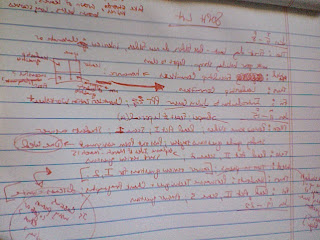
To start things off, I thought I'd give a glimpse into how I've been planning lessons for the upcoming first weeks of Spring Semester. My lesson plans typically look as they do in the picture below (backward, thanks to my Mac's PhotoBooth). It looks somewhat like a mathematical equation, but it all makes sense to me. I'll break it down in simpler phrases to post for my students' weekly updates on Homeworknow.com, which I use to keep students up to date on what we do each day in class (I can post updates, links, and documents for them!).
 So, here goes nothing! I sure hope this semester goes by as quickly as last semester did, and I hope I can stick to my goal of being organized enough to plan ahead at least 2 weeks!
To start things off, I thought I'd give a glimpse into how I've been planning lessons for the upcoming first weeks of Spring Semester. My lesson plans typically look as they do in the picture below (backward, thanks to my Mac's PhotoBooth). It looks somewhat like a mathematical equation, but it all makes sense to me. I'll break it down in simpler phrases to post for my students' weekly updates on Homeworknow.com, which I use to keep students up to date on what we do each day in class (I can post updates, links, and documents for them!).
 So, here goes nothing! I sure hope this semester goes by as quickly as last semester did, and I hope I can stick to my goal of being organized enough to plan ahead at least 2 weeks!
Subscribe to:
Posts (Atom)