Starting off the year with epics is a difficult task. Each year, my SOPH LA students must start the class by reading excerpts from at least 4 different ancient epics. If you have studied literature at all, you know what a challenge it can be just to keep the names of the characters straight! I do what I can to make it easier for my students to comprehend these complex works. That might include using puppets or cut outs to differentiate between characters, play acting what is happening, using voices to read dialogue aloud, drawing pictures on the board, or stopping frequently to explain events or words.
Some of the students are champs and, even though these texts may be difficult, stay actively engaged with my reading and the material. There are those, however, who shut down when something is beyond their comprehension, and use the difficulty of the text as an excuse to fall asleep. "I was paying attention, but I didn't understand it," they say. So instead of trying to understand it, or waiting for a moment of clarity, you give up and fall asleep??? Not only is that extremely lazy, it's also very rude. Here I am, giving it all I've got to try to help you understand something new, and you lay your head down and fall asleep. Good job.
Last week in SOPH LA, we read from the Mahabarata, the chapter about King Sibi. He is a righteous king who does everything he can to protect a dove, that has landed in his lap, from being eaten by a pushy hawk. The hawk tries everything he can to convince Sibi to give him the dove, but Sibi does not waver. Instead, Sibi offers his own flesh, equal to the weight of the dove. At the end of the story, we learn that in order to equal the weight of the dove, Sibi must give his whole self because no life is worth more than another. Good lesson right? Before we began reading, I gave the students a synopsis of the story using paper cut-outs of the characters. This got their attention, and they were interested in hearing more. As we read, the students understood the story pretty well. I stopped at various points to explain the plot, dialogue, or difficult words. Plus, they enjoyed my dramatic reading of the text. :)
This week, we read about "Sundiata" from The Epic of Mali. This one is about a boy who is born with deformities and handicaps, but is destined to be a glorious king for his people. It's a story about overcoming adversity to proove everyone wrong who doubted you. My second period is my smallest class (only 7 students), and as I read "Sundiata" aloud, one of the students fell asleep, another barely kept her eyes open, 4 had their heads down, and one was copying notes that she'd missed the previous day. There were only 2 students who were paying full attention and following along. It was so aggrivating! I told them that they should feel lucky to have a teacher who would spend so much time trying to make sure they understood such a difficult text. Of course, they tried to say, "Miss, we were paying attention!" I didn't want to hear it. I told them to work on their review guides while I wrote a detention slip for J__W___, who was sleeping. I don't care how tired you are...if there is a teacher in the room, you should be ashamed to even put your head down on the desk! I never did such a thing when I was in school! Luckily, it was a different story with my 6th period. They enjoyed listening to the story, followed along very well, and even asked questions to improve their own comprehension. What a difference!
I've found that giving my students a preview of what the story is about really does make them curious enough to want to hear more. I try to relate the preview to them as much as I can. For instance, in describing "Sundiata," I told them about the prophesy, the King who marries and ugly woman, the handicapped son, the jealous other wives of the king, the insultes, etc. I built it up, and told them that it was very much like a telenovela/soap opera. They immediately understood that the story would be filled with drama, and they wanted to know more!
Speaking of drama, my JR LA students moved on to the Puritans these past couple of weeks. First, we read two Puritan poems, and discussed the beliefs, morals, and culture of Puritans. Then, I showed them a slide show (another one that I'm proud of!) of the first Puritans to arrive in the New World, what it took for them to settle into their new lives, the growth of the colonies, then the witch trials and the Great Awakening. The students enjoyed seeing pictures of the Puritans and asked a lot of questions about them. Once we got to the witch trials, they were all excited. These past couple of days, we've been working on some pre-reading activities to get them thinking about the themes and conflicts in The Crucible. They've been writing and talking about issues like adultery, age limits in relationships, religious intollerance, forgiveness, etc. It's been an interesting concersation! Tomorrow, we'll read a synopsis of the play and discuss all of the main characters. Then, we'll read an even more succinct synopsis to make sure they have all of the main plot points in mind. After this, we'll begin reading the play! We probably won't have time to read the whole play, so we'll read enough to get the idea of the conflicts that occur in the story and then watch the film. The film version with Winona Ryder and Daniel Day Lewis really is fantastic. It's my favorite "film I'm allowed to show in school." :)
I hope the read alouds for it go well...
Wednesday, October 7, 2009

Wednesday, September 30, 2009
Floods and Travel Narratives
Last Friday, my Soph LA classes read a selection from the Bible (included in their textbooks) to compare to the "Story of the Flood" from The Epic of Gilgamesh. Many of them had already made the connection between Utnapishtim's story and Noah's story. So, as they read, they took notes on their graphic organizer table about the details of differences between these two ancient tales. Then, on Monday, I handed out a graphic organizer to help them organize their ideas for a compare and contrast essay. They used the table from the previous week to consider similarities and differences and also rewrote 3-4 particular details for each story that they thought they'd like to focus on in their body paragraphs.
On Tuesday, I told them exactly how to organize their essay and what to include in each paragraph: Intro - Hook, Background (Similarities), Thesis (3-part w/ differences); 3 Body Paragraphs - Topic Sentence (one difference each), Concrete Details from text, Commentary/Analysis, Transition sentence; Conclusion - Thesis Restatement, Summary of Main Points, and Final Thoughts. Then, I showed them an example of what a good compare-contrast essay looks like. Afterward, they had about 35 minutes to get started on their own essays. Many of them wrote at least an introduction, and some had one or two body paragraphs written. Most of them struggled to get started. I think this is normal for many students, so I don't mind if they take a while to think things through. Sometimes, if they can't get started right away, they get distracted from their task and start talking to their neighbors (thereby distracting THEM from their assignment), so I am always careful to circulate around the desks to keep a constant check of each student's progress. At the end of class, I told them to have their rough drafts done by the time they get to class the next day.
One cool moment: one of my lowest performing students stared at the assignment for a few minutes, and then said, "Miss, you should give us that paper that you gave us before to organize our essay."
"Which one, C_____?"
"You know, the one with the boxes and lines for each paragraph?"
"Oh yes! Would you like one of those?"
"Yeah. It helps me."
:)
Today, most students had their rough drafts on their desks when class began. Before I spend my time reading their work, though, I wanted to give them plenty of opportunity to self-correct. So, I put another example up on the overhead projector so they could see an "A" paper and compare their own to the example. I told them point blank: "If your paper does not look this good, you probably need to work on it a lot more." In addition to this, I also passed out a handout on a revision technique called ARMS: Add (what information should you add to benefit your reader?), Remove (what should you remove to improve the flow of your essay?), Move (can you improve the organization of your essay by moving words, sentences, or paragraphs?), Substitute (are there words, phrases, or sentences that could be improved by substituting better versions?). Each student had to read through his or her own essay and consider the ARMS, then pass it to a neighbor so they could consider the ARMS. Whatever they found that needed improvement, they had to work on it in class or as homework. They must turn in their rough drafts tomorrow for me to edit. I'll give these back to the students on Friday so they can work on their final drafts and bring them to me on Monday.
With my Jr LA classes, I've been teaching early colonization and travel narratives. We're a little behind the other classes (big surprise!), so I put together a slide show to present the 3 main types of travel narratives in the unit. First, there is the slave narrative: an excerpt from Equiano's narrative. Then, there is the journal: an excerpt from Columbus's notes on what he saw during his first voyage to America. Finally, there are narrative accounts: one excerpt from John Smith's stories of what happened at Jamestown, and the other by William Bradford about what happened at Plymouth in their first years. To get the students more interested in these people, I used photos and interesting facts about their lives to which the students could relate. It was great! They were asking questions, making comments, and telling what they already learned about the people or places in their World History class. It was a lot of fun, and it only took me a couple of hours to put together!
We started reading William Bradford's Of Plymouth Plantations afterwards, and I gave them a handout of comprehension questions to answer as we read. We've only read about half of it, and I'm already questioning whether this is the best selection for them to read. The language is pretty complicated, so they get frustrated quickly. I might do Columbus's and John Smith's excerpts next year instead....
After we finish with the travel narratives, we'll being Puritan poetry and The Crucible, which is always very exciting for me. :)
On Tuesday, I told them exactly how to organize their essay and what to include in each paragraph: Intro - Hook, Background (Similarities), Thesis (3-part w/ differences); 3 Body Paragraphs - Topic Sentence (one difference each), Concrete Details from text, Commentary/Analysis, Transition sentence; Conclusion - Thesis Restatement, Summary of Main Points, and Final Thoughts. Then, I showed them an example of what a good compare-contrast essay looks like. Afterward, they had about 35 minutes to get started on their own essays. Many of them wrote at least an introduction, and some had one or two body paragraphs written. Most of them struggled to get started. I think this is normal for many students, so I don't mind if they take a while to think things through. Sometimes, if they can't get started right away, they get distracted from their task and start talking to their neighbors (thereby distracting THEM from their assignment), so I am always careful to circulate around the desks to keep a constant check of each student's progress. At the end of class, I told them to have their rough drafts done by the time they get to class the next day.
One cool moment: one of my lowest performing students stared at the assignment for a few minutes, and then said, "Miss, you should give us that paper that you gave us before to organize our essay."
"Which one, C_____?"
"You know, the one with the boxes and lines for each paragraph?"
"Oh yes! Would you like one of those?"
"Yeah. It helps me."
:)
Today, most students had their rough drafts on their desks when class began. Before I spend my time reading their work, though, I wanted to give them plenty of opportunity to self-correct. So, I put another example up on the overhead projector so they could see an "A" paper and compare their own to the example. I told them point blank: "If your paper does not look this good, you probably need to work on it a lot more." In addition to this, I also passed out a handout on a revision technique called ARMS: Add (what information should you add to benefit your reader?), Remove (what should you remove to improve the flow of your essay?), Move (can you improve the organization of your essay by moving words, sentences, or paragraphs?), Substitute (are there words, phrases, or sentences that could be improved by substituting better versions?). Each student had to read through his or her own essay and consider the ARMS, then pass it to a neighbor so they could consider the ARMS. Whatever they found that needed improvement, they had to work on it in class or as homework. They must turn in their rough drafts tomorrow for me to edit. I'll give these back to the students on Friday so they can work on their final drafts and bring them to me on Monday.
With my Jr LA classes, I've been teaching early colonization and travel narratives. We're a little behind the other classes (big surprise!), so I put together a slide show to present the 3 main types of travel narratives in the unit. First, there is the slave narrative: an excerpt from Equiano's narrative. Then, there is the journal: an excerpt from Columbus's notes on what he saw during his first voyage to America. Finally, there are narrative accounts: one excerpt from John Smith's stories of what happened at Jamestown, and the other by William Bradford about what happened at Plymouth in their first years. To get the students more interested in these people, I used photos and interesting facts about their lives to which the students could relate. It was great! They were asking questions, making comments, and telling what they already learned about the people or places in their World History class. It was a lot of fun, and it only took me a couple of hours to put together!
We started reading William Bradford's Of Plymouth Plantations afterwards, and I gave them a handout of comprehension questions to answer as we read. We've only read about half of it, and I'm already questioning whether this is the best selection for them to read. The language is pretty complicated, so they get frustrated quickly. I might do Columbus's and John Smith's excerpts next year instead....
After we finish with the travel narratives, we'll being Puritan poetry and The Crucible, which is always very exciting for me. :)
Quote of the Day:
"Miss, what are those living-skin thingies that Utnapishtim and Noah took in their boats?"
"Living-skin thingies?"
"Yeah, they took their families and..."
"Animals?"
"Yeah! Animals! ...I'm sorry, Miss. I don't know what I was thinking. Living-skin thingies! What does that mean???"
"I don't know, but it sounds pretty scary to me."
Thursday, September 24, 2009
Gilgamesh and Native Americans
My language arts classes have moved on from their research projects to literature study. We have begun The Epic of Gilgamesh in Soph LA (world lit), and are studying Native American origin myths in Jr LA (American lit).
Teaching Gilgamesh--or any lengthy work--to ESOL students is a challenge. Their brains can only handle so many new words at once, and their attention span dwindles after about 2 pages of reading (on a good day). I knew going into this year that I wanted to shorten our study of Gilgamesh. The textbook gives us adapted versions of "The Battle with Humbaba," "The Death of Enkidu," "The Story of the Flood," and "The Return." Since we basically teach Gilgamesh to compare and contrast it to the story of Noah and the flood from the Bible and study archetype and archetypal setting, I've limited our reading to "The Story of the Flood" and "The Return." To give the students necessary background on Gilgamesh as a king and the parts of the story we didn't read, I put together a beautiful slide show in which I condensed the information and included pictures scanned from the illustrated trilogy of Gilgamesh for young readers (see links below). Also, remembering that my students have problems keeping the plot and character names straight, I included an overview of what happens in the two parts of the story that we would read together. I showed the slide show in class yesterday, and the students loved listening to it. If felt like story time in the library! :) Some of the students asked questions about the characters or plot, and they all seemed to have a general understanding of what to expect. After the slide show, we read "The Story of the Flood" together. Many of the students immediately made the connection of similarities between this flood and Noah's flood.
Today, in Soph LA, we read "The Return" together, and then students completed a table asks them to recall details about "The Story of the Flood." These details are similar to those stated in the story of Noah and the flood, so they will complete the table tomorrow after we read the excerpt from the Bible. When the table is complete, they should clearly see how the details of the stories are similar, but not exactly the same. I did notice that there were some changes to the handout that I should have made last year when I realized there was a way to make my expectations clearer. I neglected to make the changes, though. Note to self: make changes on worksheets or handouts as soon as you notice the need for correction. You won't remember to make those changes next year!
In my Jr LA class, the origin myths we're reading are "The Earth on Turtle's Back," and "When Grizzlies Walked Upright." These stories are easy to understand, and the students think it's so strange how people used to explain the natural phenomena of this world. Some of them thought the stories were cute, some thought they were funny. Since I knew they understood the stories themselves, I wanted the students to practice their organization and linear detail. They were allowed to work in small groups (3), with a partner, or as an individual; and they had to storyboard on of the origin myths we read the day before. They were limited to 8 squares, and could only use pictures. Most students have difficulty choosing which scenes to include on their storyboard. Students, overall, have very poor organization skills. This is just another area where that becomes evident. They have difficulty compartmentalizing information, too. When I first assigned the activity, the students thought it was a fun "kindergarten" activity. They soon discovered otherwise. :)
Quote of the Day:
During popcorn reading in class, a student skipped a line during her read aloud.
J_____, a short-tempered, pushy Mexican student yelled at the reader: "C____, you skipped a line, man!"
"First of all, I'm a girl not a man," she retorted in her assertive Domincan accent. "Secondly, I'm human, OK? You don't have to jump all over me for my mistakes. Now be quiet so I can read!"
Teaching Gilgamesh--or any lengthy work--to ESOL students is a challenge. Their brains can only handle so many new words at once, and their attention span dwindles after about 2 pages of reading (on a good day). I knew going into this year that I wanted to shorten our study of Gilgamesh. The textbook gives us adapted versions of "The Battle with Humbaba," "The Death of Enkidu," "The Story of the Flood," and "The Return." Since we basically teach Gilgamesh to compare and contrast it to the story of Noah and the flood from the Bible and study archetype and archetypal setting, I've limited our reading to "The Story of the Flood" and "The Return." To give the students necessary background on Gilgamesh as a king and the parts of the story we didn't read, I put together a beautiful slide show in which I condensed the information and included pictures scanned from the illustrated trilogy of Gilgamesh for young readers (see links below). Also, remembering that my students have problems keeping the plot and character names straight, I included an overview of what happens in the two parts of the story that we would read together. I showed the slide show in class yesterday, and the students loved listening to it. If felt like story time in the library! :) Some of the students asked questions about the characters or plot, and they all seemed to have a general understanding of what to expect. After the slide show, we read "The Story of the Flood" together. Many of the students immediately made the connection of similarities between this flood and Noah's flood.
Today, in Soph LA, we read "The Return" together, and then students completed a table asks them to recall details about "The Story of the Flood." These details are similar to those stated in the story of Noah and the flood, so they will complete the table tomorrow after we read the excerpt from the Bible. When the table is complete, they should clearly see how the details of the stories are similar, but not exactly the same. I did notice that there were some changes to the handout that I should have made last year when I realized there was a way to make my expectations clearer. I neglected to make the changes, though. Note to self: make changes on worksheets or handouts as soon as you notice the need for correction. You won't remember to make those changes next year!
In my Jr LA class, the origin myths we're reading are "The Earth on Turtle's Back," and "When Grizzlies Walked Upright." These stories are easy to understand, and the students think it's so strange how people used to explain the natural phenomena of this world. Some of them thought the stories were cute, some thought they were funny. Since I knew they understood the stories themselves, I wanted the students to practice their organization and linear detail. They were allowed to work in small groups (3), with a partner, or as an individual; and they had to storyboard on of the origin myths we read the day before. They were limited to 8 squares, and could only use pictures. Most students have difficulty choosing which scenes to include on their storyboard. Students, overall, have very poor organization skills. This is just another area where that becomes evident. They have difficulty compartmentalizing information, too. When I first assigned the activity, the students thought it was a fun "kindergarten" activity. They soon discovered otherwise. :)
Quote of the Day:
During popcorn reading in class, a student skipped a line during her read aloud.
J_____, a short-tempered, pushy Mexican student yelled at the reader: "C____, you skipped a line, man!"
"First of all, I'm a girl not a man," she retorted in her assertive Domincan accent. "Secondly, I'm human, OK? You don't have to jump all over me for my mistakes. Now be quiet so I can read!"
Wednesday, September 16, 2009
Presentation Day
Some were better than others, but I was proud of most of my students and their presentations today. Most of them dressed up for the occasion (despite the pouring rain!), and many of them had clearly practiced.
Of course, there were some let downs. Students who had not been keeping up with their work did not pull magic rabbits out of their hats and miraculously have something ready to present. There were some stand-outs, though: students who did surprisingly well for their first public presentation.
The day was marred, though, by an incident in 3rd period. One of my sweetest, most polite male students, T_____, received a letter from the front office last week saying that they didn't have his address on record. T_____ told me that his family had moved and that he was supposed to be at a different school, but since he only had 8 more months to go, he wanted to stay at CHHS and graduate with his friends. He's been worried about it ever since. Today, he was not in class when it was time for him to present with his group. His 2 group mates began without him, and just as A_____ said, "My friend, T_____ could not be here today, so we are just going to explain his slides to you," T______ walked through the door. We were all happy to see him and everyone called out his name.
"T____!" I said, "You have perfect timing! Your group was just about to read your slides to us."
"Oh," he looked at the class, then back at me. Something was wrong. T_____'s mother poked her head through the door, and I knew what was going on. There's only one reason an ESOL parent comes to school in the middle of the day: withdrawl. I looked at T_____, and he turned to his group mates. "Guys, I can't present. I have to go to a new school."
The class gasped in unison. We all love T_____. He's one of the most jovial people I've ever met. "What? Why?" They all wanted an explanation.
"Class," I tried to explain, "T_____has moved to another district, so he has to go to the school there." I started tearing up (which I couldn't believe).
I crossed the room and gave T______'s mother a hug. "We had to move," she said in a thick Vietnamese accent. "I know." I told her.
T_____ was becoming emotional, which is absolutely not allowed for a young man in front of a crowd (grin), so he walked toward me and the door. I gave him a hug and said goodbye.
Many times, when I say goodbye to a student, it's forever. They don't keep email addresses, they don't write for letters of recommendation, they don't come back to visit. My students live such transient existences that it's difficult for them to stay in touch with anyone. ... I don't think I'll see or hear from T____ again, which makes me sad. That's one of the worst parts of my job.
One of the coolest parts of my job, though, is that I am the only teacher at CHHS who teaches SOPH LA and JR LA for ESOL students. I have these students for 2 years. We are a small unit. We are very like a family. Everyone knows everyone, and we all try to get along. There is comfort in that, and the students rely on that routine and consistency at school. It is hard, though, when there is a big change, and one of our family members is no longer there. You can feel that the classroom has a different dynamic...even when one person is absent.
Anyhow...now that presentations are done, I need to find some way to transition my students over to literature studies. I think I'll do a textbook exploration activity tomorrow to introduce them to the different parts of the text. They need to know how to use a Table of Contents, a Glossary, and an Index. Then, I'll have to introduce Native American Lit for my JR LA class and Gilgamesh (and the epic cycle) to my SOPH LA class.
...I think we're having pizza tonight. That is way too much to get done to cook dinner, too. LOL
I need to use time this weekend to plan ahead for the next 2 weeks. I'm getting bad again about doing my planning the night before, and that just stresses me out.
The main speaker below is one of my Korean students. She was a good sport about us pointing out her pronunciation error, and said that her bf had even pointed it out to her. She said she was just too nervous to concentrate on fixing it for us. :)
Quote of the Day:
Presenter S____: "Good morning. Today we're going to talk about bling. Do you know what bling is?"
Audience Member with a Spanish accent: "Little sparkly things?"
Presenter S____: "No. Bling is when you make someone feel bad about themselves because of how they dress, look, act, or because of who they hang out with. There are many factors that would cause someone to bully someone else. We are going to talk about those factors, how to stop it, and where to go for help is someone is bling you."
Of course, there were some let downs. Students who had not been keeping up with their work did not pull magic rabbits out of their hats and miraculously have something ready to present. There were some stand-outs, though: students who did surprisingly well for their first public presentation.
The day was marred, though, by an incident in 3rd period. One of my sweetest, most polite male students, T_____, received a letter from the front office last week saying that they didn't have his address on record. T_____ told me that his family had moved and that he was supposed to be at a different school, but since he only had 8 more months to go, he wanted to stay at CHHS and graduate with his friends. He's been worried about it ever since. Today, he was not in class when it was time for him to present with his group. His 2 group mates began without him, and just as A_____ said, "My friend, T_____ could not be here today, so we are just going to explain his slides to you," T______ walked through the door. We were all happy to see him and everyone called out his name.
"T____!" I said, "You have perfect timing! Your group was just about to read your slides to us."
"Oh," he looked at the class, then back at me. Something was wrong. T_____'s mother poked her head through the door, and I knew what was going on. There's only one reason an ESOL parent comes to school in the middle of the day: withdrawl. I looked at T_____, and he turned to his group mates. "Guys, I can't present. I have to go to a new school."
The class gasped in unison. We all love T_____. He's one of the most jovial people I've ever met. "What? Why?" They all wanted an explanation.
"Class," I tried to explain, "T_____has moved to another district, so he has to go to the school there." I started tearing up (which I couldn't believe).
I crossed the room and gave T______'s mother a hug. "We had to move," she said in a thick Vietnamese accent. "I know." I told her.
T_____ was becoming emotional, which is absolutely not allowed for a young man in front of a crowd (grin), so he walked toward me and the door. I gave him a hug and said goodbye.
Many times, when I say goodbye to a student, it's forever. They don't keep email addresses, they don't write for letters of recommendation, they don't come back to visit. My students live such transient existences that it's difficult for them to stay in touch with anyone. ... I don't think I'll see or hear from T____ again, which makes me sad. That's one of the worst parts of my job.
One of the coolest parts of my job, though, is that I am the only teacher at CHHS who teaches SOPH LA and JR LA for ESOL students. I have these students for 2 years. We are a small unit. We are very like a family. Everyone knows everyone, and we all try to get along. There is comfort in that, and the students rely on that routine and consistency at school. It is hard, though, when there is a big change, and one of our family members is no longer there. You can feel that the classroom has a different dynamic...even when one person is absent.
Anyhow...now that presentations are done, I need to find some way to transition my students over to literature studies. I think I'll do a textbook exploration activity tomorrow to introduce them to the different parts of the text. They need to know how to use a Table of Contents, a Glossary, and an Index. Then, I'll have to introduce Native American Lit for my JR LA class and Gilgamesh (and the epic cycle) to my SOPH LA class.
...I think we're having pizza tonight. That is way too much to get done to cook dinner, too. LOL
I need to use time this weekend to plan ahead for the next 2 weeks. I'm getting bad again about doing my planning the night before, and that just stresses me out.
The main speaker below is one of my Korean students. She was a good sport about us pointing out her pronunciation error, and said that her bf had even pointed it out to her. She said she was just too nervous to concentrate on fixing it for us. :)
Quote of the Day:
Presenter S____: "Good morning. Today we're going to talk about bling. Do you know what bling is?"
Audience Member with a Spanish accent: "Little sparkly things?"
Presenter S____: "No. Bling is when you make someone feel bad about themselves because of how they dress, look, act, or because of who they hang out with. There are many factors that would cause someone to bully someone else. We are going to talk about those factors, how to stop it, and where to go for help is someone is bling you."
Tuesday, September 15, 2009
The Day Before...
Tomorrow is the big day...Presentation Day! My students are both excited and nervous. They've been working so hard to prepare, but have not practiced enough, and they know it! :)
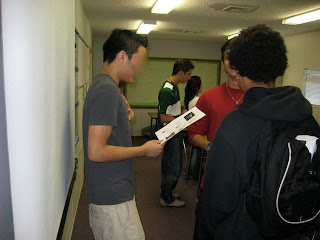
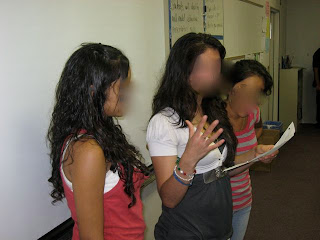
Today, I gave them one more day in class to practice with each other. They had to time each other as they practiced their speaking and using their PPT slides effectively.
To begin class, I showed a clip from one of Apple's keynote presentations. This way, the students could see what a top-notch presentation should look like and how minimal information on PPT slides is used to help keep the audience up with what the speaker is saying. Many of them still have too much information on their slides, but hopefully they'll improve next time. (I am definitely going to make them do more presentations this year!) As they watched the clip, I pointed out the use of slides, body language, clearly spoken words, speaking rather than reading information, and other successful presentation skills. The students enjoyed watching the clip and were inspired to practice their own presentations!
They all split up into their groups, or went their own way if they are presenting solo. They made notes on what they would each say during their presentations, created note cards, timed each other, ran through their lines, critiqued each other, and asked me and each other questions. If the student was working independently, they practiced their lines and had me or someone else time them as they gave their presentation a test run.
Here are some photos of the day's happenings:
(BTW, in these photos alone, 10 countries are represented: France, Rwanda, Korea, Vietnam, Dominican Republic, Nepal, Cuba, India, Mexico, and the USA!)




Quote of the Day:
"Oh, Miss, you need that fixed? Lemme try. I have Asian technology skills."
"Asian technology skills?"
"Yeah, can fix anything. Watch." ... (he skillfully replaces the fabric back piece on my director's chair)
"See, Asian technology."
"What does that have to do with technology?"
"I'm Asian. I fix it. Technology."
"I think you are confused...."
Today, I gave them one more day in class to practice with each other. They had to time each other as they practiced their speaking and using their PPT slides effectively.
To begin class, I showed a clip from one of Apple's keynote presentations. This way, the students could see what a top-notch presentation should look like and how minimal information on PPT slides is used to help keep the audience up with what the speaker is saying. Many of them still have too much information on their slides, but hopefully they'll improve next time. (I am definitely going to make them do more presentations this year!) As they watched the clip, I pointed out the use of slides, body language, clearly spoken words, speaking rather than reading information, and other successful presentation skills. The students enjoyed watching the clip and were inspired to practice their own presentations!
They all split up into their groups, or went their own way if they are presenting solo. They made notes on what they would each say during their presentations, created note cards, timed each other, ran through their lines, critiqued each other, and asked me and each other questions. If the student was working independently, they practiced their lines and had me or someone else time them as they gave their presentation a test run.
Here are some photos of the day's happenings:
(BTW, in these photos alone, 10 countries are represented: France, Rwanda, Korea, Vietnam, Dominican Republic, Nepal, Cuba, India, Mexico, and the USA!)


Quote of the Day:
"Oh, Miss, you need that fixed? Lemme try. I have Asian technology skills."
"Asian technology skills?"
"Yeah, can fix anything. Watch." ... (he skillfully replaces the fabric back piece on my director's chair)
"See, Asian technology."
"What does that have to do with technology?"
"I'm Asian. I fix it. Technology."
"I think you are confused...."
Monday, September 14, 2009
Practice, Practice, Practice!
On Friday, September 11th, I was already in a touchy mood, so I didn't want to do anything that required too much effort on my part. That may sound bad, buy you know that we all have those days. I still wanted to pack my students' brains full of information, though! I was thinking about what I wrote in my previous post...about helping the students understand how to prepare for their presentation, and the difference between a good and bad presentation.
I decided that I should first assess how much they already knew. Some of them have already taken Business Essentials as an elective, and have had to learn about presentation skills. So, I had them do a Think-Pair-Share to brainstorm ideas of what it takes to give a successful presentation. Here's the list that my 6th period came up with:

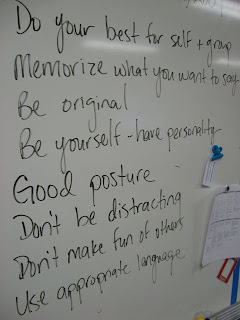
After the brainstorming session, I passed out copies of these two articles:
http://www.businessweek.com/smallbiz/content/aug2009/sb20090825_379576.htm
http://www.ehow.com/how_2161539_give-presentation-class.html
The first article takes a humorous approach to teaching presentation skills. The author gives instructions on how to give a lousy presentation. So, the students figured that everything the author says to do, they should do the opposite. The students took turns reading the points out loud, and we discussed what would be the correct action to take. This brought up quite a few questions! Sometimes, the students were able to answer their peers' questions. Other times, I answered.
The second article highlights some was to prepare for giving a presentation. This article stresses the importance of practicing. I told the students what my Public Speaking professor told his classes in college: "Practice, practice, practice until you think you've got it. Then, practice once more to be sure." This helped drive the point home that I have high expectations of their performance on Wednesday. Dressing the part (they have to dress business-casual) does not make you automatically successful. You must practice and work to be your best.
Today, Monday, they were all supposed to turn in their PowerPoint presentations. Many of them were ready, but a few students/groups needed more time. I told them they had to get the slide show to be by the end of the day (3PM) or it would be late with points counted off. For those who were ready, I printed a handout of their show, and asked them to make brief notations beside each slide to tell me who would be speaking during that slide and what they would say.
Before all of that, the students had to take their MLA Citations Quiz today. There was a wide range of scores, but only a handful of students failed. This shows me that they just need time to soak in the information, and they need to see it repeatedly. In the past, I've tried to teach MLA at the end of the year within a very limited time frame, and the students just don't get it. This year, as this quiz has shown me, they have understood much better.
I was reminded today that our first Benchmark Exam is on October 7th. By this date (according to the county pacing guide), my JR LA students should have studied Native American Lit, Exploration Narratives (ex: John Smith), Equiano, The Crucible, and Puritan Poetry. My SOPH LA students should have studied Gilgamesh, the Bible, and at least 2 other epics. ...That is not going to happen. I gave as much time as my students needed to feel confident in the research process and essay writing. I know that they can do this. I feel confident in sending them to take the GHSGWT at the end of Sept. (with a little more practice in persuasive writing, of course). Now that I know they can organize their ideas, and write strong paragraphs, we can move on to the literature. What is the point of teaching, if the students don't have time to learn?
I guess I better get planning. We have a lot to do in the next couple of weeks! :)
I decided that I should first assess how much they already knew. Some of them have already taken Business Essentials as an elective, and have had to learn about presentation skills. So, I had them do a Think-Pair-Share to brainstorm ideas of what it takes to give a successful presentation. Here's the list that my 6th period came up with:


After the brainstorming session, I passed out copies of these two articles:
http://www.businessweek.com/smallbiz/content/aug2009/sb20090825_379576.htm
http://www.ehow.com/how_2161539_give-presentation-class.html
The first article takes a humorous approach to teaching presentation skills. The author gives instructions on how to give a lousy presentation. So, the students figured that everything the author says to do, they should do the opposite. The students took turns reading the points out loud, and we discussed what would be the correct action to take. This brought up quite a few questions! Sometimes, the students were able to answer their peers' questions. Other times, I answered.
The second article highlights some was to prepare for giving a presentation. This article stresses the importance of practicing. I told the students what my Public Speaking professor told his classes in college: "Practice, practice, practice until you think you've got it. Then, practice once more to be sure." This helped drive the point home that I have high expectations of their performance on Wednesday. Dressing the part (they have to dress business-casual) does not make you automatically successful. You must practice and work to be your best.
Today, Monday, they were all supposed to turn in their PowerPoint presentations. Many of them were ready, but a few students/groups needed more time. I told them they had to get the slide show to be by the end of the day (3PM) or it would be late with points counted off. For those who were ready, I printed a handout of their show, and asked them to make brief notations beside each slide to tell me who would be speaking during that slide and what they would say.
Before all of that, the students had to take their MLA Citations Quiz today. There was a wide range of scores, but only a handful of students failed. This shows me that they just need time to soak in the information, and they need to see it repeatedly. In the past, I've tried to teach MLA at the end of the year within a very limited time frame, and the students just don't get it. This year, as this quiz has shown me, they have understood much better.
I was reminded today that our first Benchmark Exam is on October 7th. By this date (according to the county pacing guide), my JR LA students should have studied Native American Lit, Exploration Narratives (ex: John Smith), Equiano, The Crucible, and Puritan Poetry. My SOPH LA students should have studied Gilgamesh, the Bible, and at least 2 other epics. ...That is not going to happen. I gave as much time as my students needed to feel confident in the research process and essay writing. I know that they can do this. I feel confident in sending them to take the GHSGWT at the end of Sept. (with a little more practice in persuasive writing, of course). Now that I know they can organize their ideas, and write strong paragraphs, we can move on to the literature. What is the point of teaching, if the students don't have time to learn?
I guess I better get planning. We have a lot to do in the next couple of weeks! :)
Thursday, September 10, 2009
Creating Presentations
Friday, the students began or continuted working on their PowerPoint presentations or finding and printing pictures for their posters. It was a good day, and everyone was engaged in their assignment. Some of the students chose to work individually on their presentation, and most of them chose to work in pairs or small groups. They understand that their presentation must be 4-5 minutes in length, and that they all have to participate in the production and presentation of the information.
On Monday, there was no school because of Labor Day. So, on Tuesday, we met in the trailer, and I brought brownies to share with everyone. In each class, somone asked, "Miss, why are we getting brownies today?" I told them, "You're getting brownies because I am so proud of each of you for working hard on your research projects." This made them very happy, and it did make them feel good about the work they've done. Before I gave them the brownies (while I still had their attention!), we did a quick review about citations. I wrote 3 citations on the board, leaving 6-8 mistakes in each of them. The students had to copy the citations onto their paper, and correct the mistakes. We worked together to correct them on the board. This was good because I saw that many of the students were still confused about when to used quotations or underline for titles.
Tuesday was a different story... it was a bad day. Many of the students were unfocused, were in a bad mood, or were just plain lazy. Today was their last day in the computer lab to work on their presentations. I was thinking about booking another day for them to be in the lab, but then I had second thoughts. No. If they still aren't finished after I've given them plenty of time to work, they'll need to finish on their own time. Yes! It was so liberating to set my mind on putting the responsibility on the student (where it should be!). I'm not going to give as many chances or be as sympathetic to students who don't get their work done. That just takes up too much of my time and energy, and makes them think it's OK to slack off.
Today was a much better day. For my LA classes, I gave my students an MLA Citations Review of 25 questions. There were different sections where students had to identify the correct citation, answer True/False questions about MLA format, fix incorrect citations, and label the parts of a citation. It was interesting to see how much they've learned from our research project. They had to complete the review quietly and independently first, and then we went over it as a class. I heard one student say to himself, "This is a good review." That made me happy. What I really liked, though, was when most students got a question incorrect, they wanted to know what the right answer was and WHY it was the right answer. I love that! To make sure I called on them randomly, I put all of their names on popsicle sticks, and picked the sticks out of a cup. It's so funny how quiet the room gets right before I pick a stick. Everyone waits to hear their name. :) It was a lot more fun than I planned.
Tomorrow, I want to start giving the students tips on how to give a professional presentations. I want to show them example cue cards, and show them how to used a PowerPoint slide show effectively as PART of the presentation. The focus, they need to understand, should be on the speaker and not the slide show. I'm not sure how best to convey this to them....
In my LDC IV classes, the students worked on a review of 9 sets of questions over Chapters 1-8 of Tuck Everlasting. I could tell which students had been paying attention, and which ones were clueless. One of my students, K____, actually fell asleep with his earphones in his ears during reading time on Monday! When I handed him the review, he just sat there and stared at it for about 15 minutes. When I noticed him, I told him it would be better to go back and read what he missed on Monday. Most of the students did pretty well in refering back to the book to find answers to the questions. I included the page numbers where they could find the answers, but they had to do the rest themselves.
On Monday, there was no school because of Labor Day. So, on Tuesday, we met in the trailer, and I brought brownies to share with everyone. In each class, somone asked, "Miss, why are we getting brownies today?" I told them, "You're getting brownies because I am so proud of each of you for working hard on your research projects." This made them very happy, and it did make them feel good about the work they've done. Before I gave them the brownies (while I still had their attention!), we did a quick review about citations. I wrote 3 citations on the board, leaving 6-8 mistakes in each of them. The students had to copy the citations onto their paper, and correct the mistakes. We worked together to correct them on the board. This was good because I saw that many of the students were still confused about when to used quotations or underline for titles.
Tuesday was a different story... it was a bad day. Many of the students were unfocused, were in a bad mood, or were just plain lazy. Today was their last day in the computer lab to work on their presentations. I was thinking about booking another day for them to be in the lab, but then I had second thoughts. No. If they still aren't finished after I've given them plenty of time to work, they'll need to finish on their own time. Yes! It was so liberating to set my mind on putting the responsibility on the student (where it should be!). I'm not going to give as many chances or be as sympathetic to students who don't get their work done. That just takes up too much of my time and energy, and makes them think it's OK to slack off.
Today was a much better day. For my LA classes, I gave my students an MLA Citations Review of 25 questions. There were different sections where students had to identify the correct citation, answer True/False questions about MLA format, fix incorrect citations, and label the parts of a citation. It was interesting to see how much they've learned from our research project. They had to complete the review quietly and independently first, and then we went over it as a class. I heard one student say to himself, "This is a good review." That made me happy. What I really liked, though, was when most students got a question incorrect, they wanted to know what the right answer was and WHY it was the right answer. I love that! To make sure I called on them randomly, I put all of their names on popsicle sticks, and picked the sticks out of a cup. It's so funny how quiet the room gets right before I pick a stick. Everyone waits to hear their name. :) It was a lot more fun than I planned.
Tomorrow, I want to start giving the students tips on how to give a professional presentations. I want to show them example cue cards, and show them how to used a PowerPoint slide show effectively as PART of the presentation. The focus, they need to understand, should be on the speaker and not the slide show. I'm not sure how best to convey this to them....
In my LDC IV classes, the students worked on a review of 9 sets of questions over Chapters 1-8 of Tuck Everlasting. I could tell which students had been paying attention, and which ones were clueless. One of my students, K____, actually fell asleep with his earphones in his ears during reading time on Monday! When I handed him the review, he just sat there and stared at it for about 15 minutes. When I noticed him, I told him it would be better to go back and read what he missed on Monday. Most of the students did pretty well in refering back to the book to find answers to the questions. I included the page numbers where they could find the answers, but they had to do the rest themselves.
Subscribe to:
Posts (Atom)